Why Your Website Isn't Converting (And How to Fix It)
At CodeRift, we have audited over 100 small business websites, and we constantly see companies losing money over easily fixable website conversion mistakes. You do not always need a massive, expensive redesign to fix a low conversion rate. Often, a few strategic tweaks can dramatically improve landing page conversions and turn passive readers into paying clients.
Before you spend thousands of dollars on a new layout, you need to understand the root cause of your lost leads. Let's break down exactly why websites fail in 2026 and explore five free website fixes you can implement today.
What It Means When a Website Isn't Converting
The average website converts only 2.35% of visitors into leads or sales. This means that out of every 100 people who visit your site, fewer than three will actually reach out to you. Because the baseline is so low, even small improvements can make a massive difference to your bottom line.
Before you start changing your colors and fonts, you need to check your traffic sources. Often, the issue is an intent mismatch where the wrong audience is finding your site, rather than a broken website experience. If you sell premium consulting but attract visitors looking for free DIY guides, your conversion rate will always be zero.
Common pitfall to avoid: Do not confuse a traffic quality problem with a website design problem. If your bounce rate is high, verify that your ads and search keywords actually match the offer on your landing page.
Once you confirm that the right people are visiting your site, it is time to look at the user experience. The following five free fixes address the most common reasons why your website isn't converting.

Fix 1: Clarify Your Value Proposition
Data from 2026 shows that 68% of websites fail because visitors simply do not understand why they should care about the product or service. The biggest conversion killer is not graphic design, but an unclear value proposition. If people are confused, they will leave.
You need to avoid vague, clever headlines that sound poetic but mean nothing. Visitors need to know exactly what you do, who you do it for, and how it helps them within three seconds of landing on your page. If they have to scroll to figure out what you sell, you have already lost them.
Action: Rewrite your main homepage headline today. Clearly state the specific problem you solve for your exact target customer. Instead of "Empowering Your Future," use "We Help Plumbers Get More Local Leads."
A staggering 61% of sites suffer from a trust deficit, which creates "friction in belief" and stops people from buying. You are asking strangers on the internet to hand over their hard-earned money or sensitive contact information. If your site looks sketchy or lacks social proof, they will hesitate.
Small businesses often forget to include basic credibility markers that make customers feel safe. A modern site must prove its legitimacy instantly. Without trust, even the best product will struggle to sell.
Quick tip: Add real customer testimonials, industry certifications, and secure payment badges near your checkout or contact forms. Even a simple "Rated 5 Stars on Google" badge can provide a 15–40% lift in conversions.
If you want to see how we build trust into our own client projects, check out our web design services page. We always prioritize trust signals above the fold.
Fix 3: Speed Up Your Mobile Experience
In 2026, over 65% of AI-referred traffic arrives on mobile devices, yet 54% of sites still deliver a poor mobile experience. Many business owners mistakenly believe that having a "responsive" site is enough. However, if your mobile site is clunky, hard to read, or slow, you are actively driving customers away.
Every single second of load time can reduce your conversions by about 7%. Speed is a direct revenue problem, not just a technical issue for your IT guy to worry about. If your site takes five seconds to load on a 5G connection, your competitors are stealing your business.
Action: Compress your large images using free online tools. Ensure your mobile layout is simple, fast, and easy to navigate with one thumb. Read our latest blog post on mobile optimization for a step-by-step guide.
Fix 4: Make Your Call to Action (CTA) Obvious
Roughly 70% of small business websites do not have a clear, visible call to action on their homepage. If you do not explicitly tell your visitors what to do next, they will do nothing. You must guide them by the hand toward the sale.
Generic buttons like "Contact Us," "Learn More," or "Submit" severely underperform because they do not communicate any value to the user. Your button needs to promise a specific outcome that the user actually wants.
Action: Change your button text to action-driven phrases like "Get Your Free Quote," "Book a Consultation," or "Start Your Free Trial." Make sure the button color heavily contrasts with the rest of your website so it is impossible to miss.
Fix 5: Check Your Traffic Intent
As mentioned earlier, traffic quality is frequently confused with conversion performance. You might have a beautifully designed, fast-loading website with a great CTA, but if you are attracting the wrong people, your conversion rate will remain at zero. This is a classic intent mismatch.
For example, if your blog ranks highly for a "how-to" guide, those visitors are likely looking for free information, not a paid service. You need to ensure your high-intent pages (like your service or pricing pages) are getting the right kind of traffic from your ads and search efforts.
Important context: Review your analytics to see which pages have the highest bounce rates. If a page gets thousands of views but zero clicks, the content likely does not match what the user searched for.
Comparing Low-Converting vs. High-Converting Websites
To summarize these small business website tips, here is a quick look at the difference between a site that bleeds traffic and one that generates leads.
| Website Element |
Low-Converting Mistake |
High-Converting Fix |
| Headline |
Vague, clever, or company-focused. |
Clear, problem-solving, and customer-focused. |
| Trust Signals |
Hidden reviews or missing security badges. |
Prominent testimonials and visible certifications. |
| Mobile Speed |
Large images causing 4+ second load times. |
Compressed media loading in under 2 seconds. |
| Call to Action |
Generic "Submit" or "Contact Us" buttons. |
Actionable "Get a Free Quote" buttons in contrasting colors. |
Key Takeaways
Fixing a low conversion rate does not always require a massive budget. By focusing on the user experience and clearing away confusion, you can see immediate results.
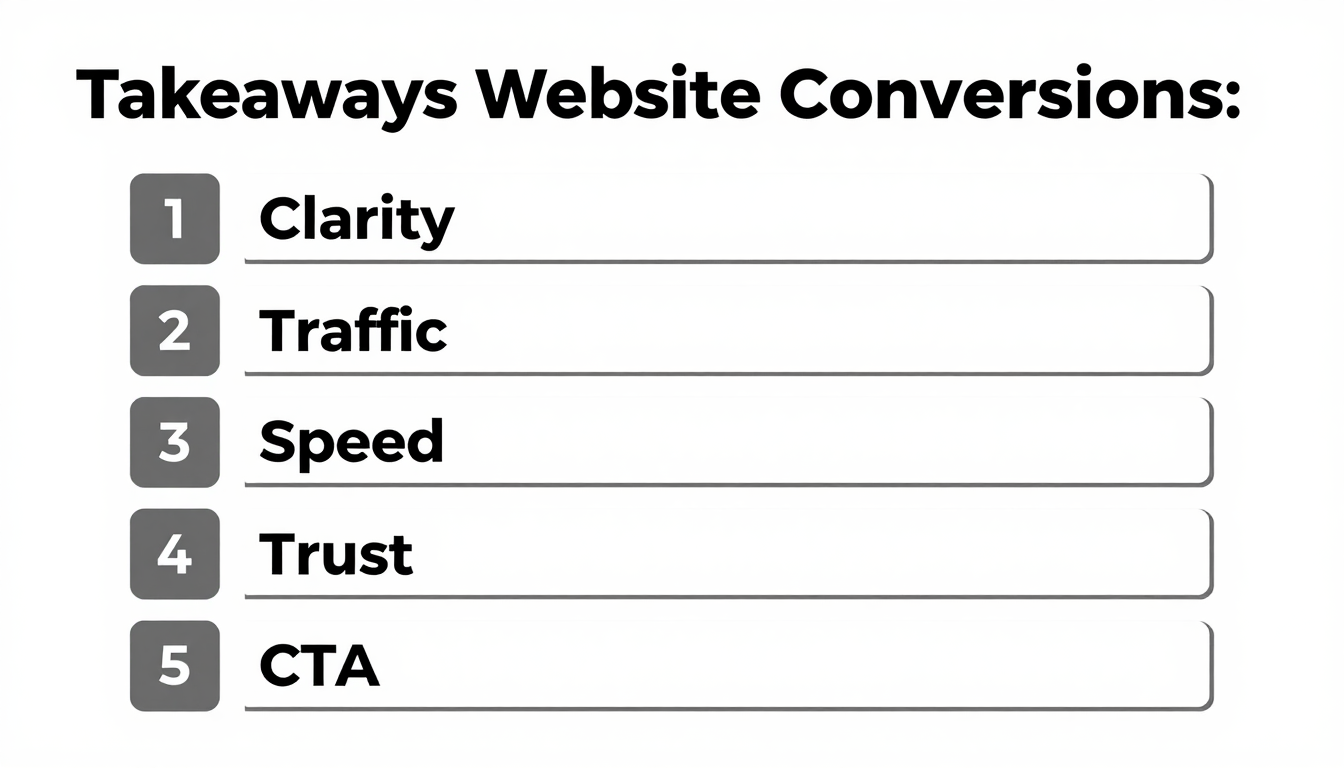
- Clarity beats cleverness: A low conversion rate is almost always caused by unclear messaging, not bad graphic design.
- Verify your traffic: Always ensure you are attracting the right audience with the right intent before you overhaul your website.
- Speed equals revenue: Every second of mobile load time costs you 7% of your conversions. Compress your images.
- Build instant trust: Strangers need proof. Prominently display reviews, awards, and security badges.
- Strengthen your CTA: Tell users exactly what they get when they click your button. Ditch the generic "Submit" text.
Frequently Asked Questions (FAQ)
What is a good website conversion rate in 2026?
The average website converts at roughly 2.35%. However, a "good" conversion rate depends heavily on your industry. Top-performing sites often see conversion rates between 5% and 11%. If you are sitting below 2%, implementing basic free website fixes can yield significant improvements.
How do I fix a low conversion rate fast?
The fastest way to fix a low conversion rate is to clarify your main headline and make your Call to Action (CTA) highly visible. Ensure visitors know exactly what you do within three seconds, and give them a brightly colored button that offers immediate value, like "Book a Free Call."
Does page speed really affect my bottom line?
Yes. Data shows that every additional second of load time reduces conversions by about 7%. Since over 65% of AI-referred traffic now comes from mobile devices, a slow website directly causes users to bounce and shop with your competitors instead.
Ready to Optimize Your Site with AI?
Modern AI tools can help you analyze visitor behavior, rewrite weak headlines, and identify exactly where people are dropping off your site. You no longer have to guess why your website isn't converting. By leveraging data, you can make targeted improvements that drive real revenue.
You don't need to be tech-savvy to use these tools. At CodeRift Agency, we help small businesses implement simple AI solutions and high-converting designs to boost sales. If you are tired of losing leads to your competitors, check out our pricing plans to see how affordable a high-performance website can be.
Stop leaving money on the table with a site that underperforms. Contact us today or book a free audit call to learn how we can help you turn your website into a 24/7 lead generation machine.