The Hidden Cost of a Bad Website: Why Most Small Business Websites Fail
Unfortunately, why small business websites fail often comes down to a fundamental misunderstanding of their purpose. If your site isn't generating revenue, it is costing you money every single day in missed opportunities.
When a visitor lands on your page, you have mere seconds to convince them to stay. If your design looks dated, confusing, or broken, they will hit the back button instantly. This reality check, reflected in a high bounce rate, is a clear signal that your digital presence is damaging your brand trust rather than building it.
Reason 1: Is Your Value Proposition Clear?
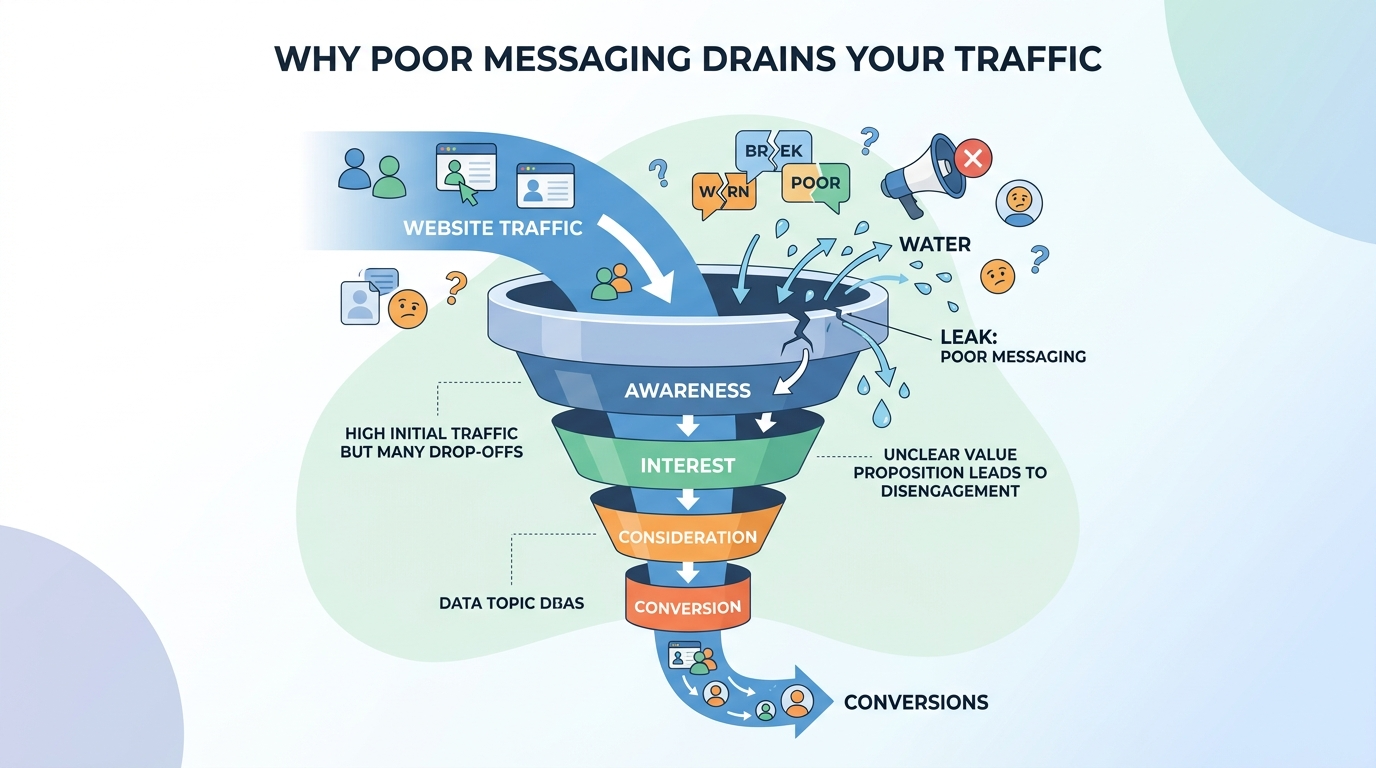
The "5-second rule" is simple: when a new visitor lands on your home page, they must understand exactly what you do and how you help them within five seconds. If they have to hunt for your services, you have already lost them.
Most business owners make the mistake of focusing on their own features or history. Your customers do not care about your story until they know you can solve their specific problem.
To fix your value proposition:
- Lead with the benefit: Start your headline with the outcome the customer gets, not the service you provide.
- Focus on pain points: Use your sub-headline to address the specific frustration your customer is currently facing.
- Keep it concise: Avoid industry jargon. Use simple, direct language that a fifth-grader could understand.
Quick tip: Ask a friend who knows nothing about your business to look at your site for five seconds. Close the tab and ask them what you do. If they can't answer, your messaging needs work.
Reason 2: Why Do You Lack Clear Calls to Action (CTAs)?
A website without a clear path forward is a maze. By forcing your visitors to guess what to do next, you create decision fatigue that causes them to leave.
You need to eliminate the guesswork. Every page on your site should have one primary, high-visibility call to action, often called a CTA. If you have five different buttons all competing for attention, your visitors will likely click none of them.
Optimize your calls to action by:
- Placing them above the fold: Ensure your primary CTA is visible immediately when the page loads, without requiring any scrolling.
- Using high-contrast colors: Your button should stand out against the rest of your site’s design to grab attention instantly.
- Using low-friction text: Instead of generic terms like "Submit," use action-oriented phrases like "Get My Free Quote" or "Book My Strategy Call."
Reason 3: Is Your Site Truly Mobile-Friendly?
Google now uses mobile-first indexing, meaning they primarily look at the mobile version of your site to determine its search ranking. If your site performs poorly on a phone, it is virtually invisible to your best customers in 2026.
Common pitfall to avoid: Do not settle for a site that just "shrinks" down to fit a phone. If a user has to "pinch-and-zoom" to read your text or click a link, your design is failing the user experience test.
A mobile-friendly site is about navigation and readability. Ensure your text is large enough to read without zooming, and make sure your buttons are spaced widely enough to be tapped with a thumb without accidentally clicking the wrong link.
Image: A side-by-side view of a website showing a frustrating, non-responsive design versus a clean, mobile-optimized experience.
Reason 4: How Do Slow Loading Speeds Hurt Your Conversions?
In the digital age, patience is non-existent. Research consistently shows that every additional second of load time leads to a measurable drop in your website conversion rate.
If your site takes more than three seconds to load, a massive portion of your potential leads will leave before they even see your content. Slow speeds are usually caused by:
- Unoptimized images: Massive, high-resolution photos that aren't compressed.
- Bloated plugins: Too many background tools running on your CMS that slow down the server response.
- Poor hosting: Choosing the cheapest, most crowded server environment for your business.
Action Plan: Fixing Your Website Without a Technical Degree
You don't need to be a developer to improve your site. You just need a systematic approach to fixing these common performance issues.
Start by auditing your site using free tools like Google Search Console or PageSpeed Insights. These tools will give you a list of technical red flags that you can hand off to a professional or address one by one.
Next, audit your navigation. If your menu has more than five items, you are cluttering your site. Remove unnecessary pages and focus on the information that actually drives sales.
Important context: Knowing when to DIY and when to outsource is a key skill. If your site is your primary lead generation engine, professional intervention is often the fastest path to a positive return on investment.
Image: A simplified checklist graphic summarizing the "Fix, Streamline, Outsource" workflow.
Frequently Asked Questions
What is a good conversion rate for small businesses?
Most small business websites see conversion rates between 1% and 3%. However, this varies significantly by industry. Focus on incremental improvements—if you can move from 1% to 2%, you have effectively doubled your lead generation.
How often should I update my website?
You should review your content and performance metrics every quarter. A full design refresh is usually recommended every 2 to 3 years to ensure you remain competitive with modern mobile-first design standards.
Is it better to use a template or custom design?
Templates are excellent for getting started quickly and on a budget. However, as your business grows, a custom design often provides better speed, clearer branding, and the flexibility to implement specific website lead generation strategies that generic templates lack.
Ready to turn your website into a lead-generating machine?
Stop guessing why your traffic isn't converting. Book a free, no-obligation audit with the CodeRift team today. We will identify the specific bottlenecks holding your business back and show you exactly how to fix them.