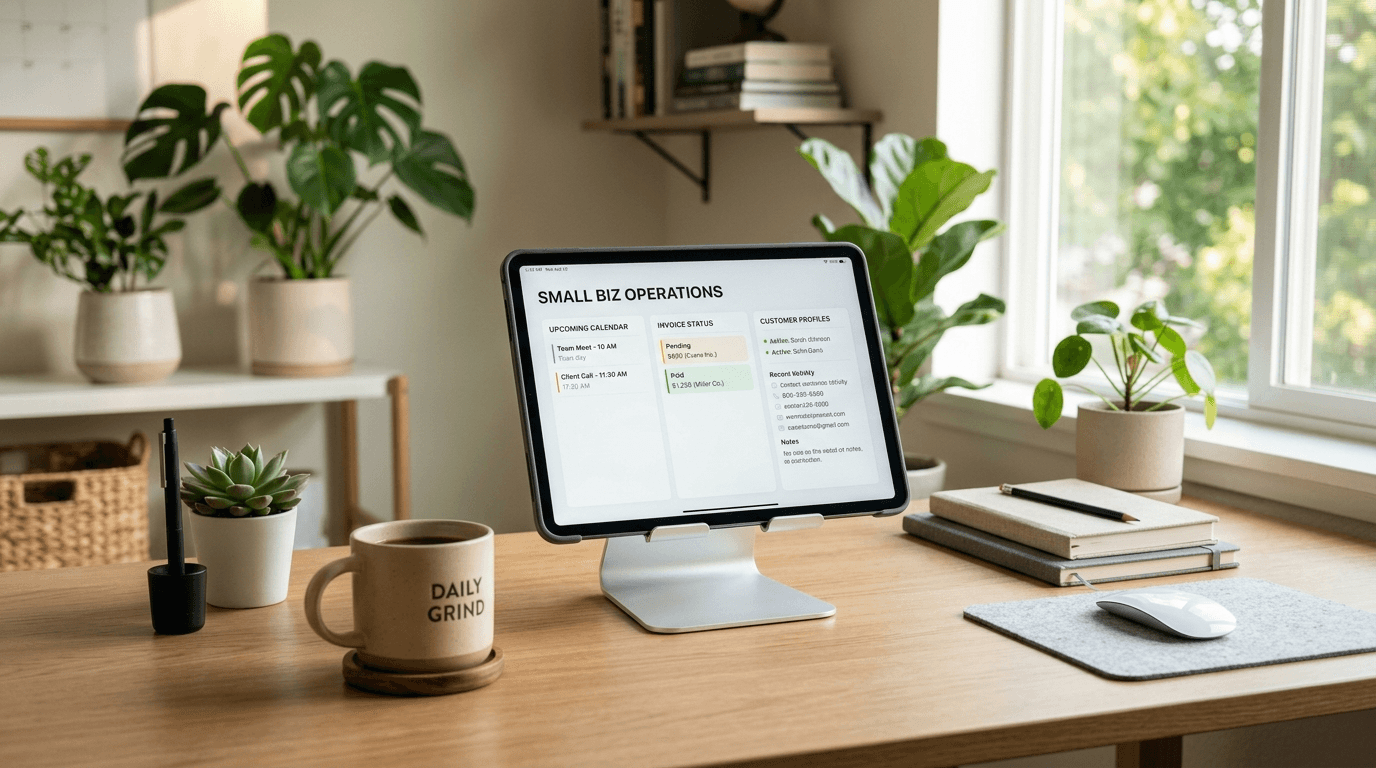
What is CRM Automation, and Why Do You Need It?
Think of your CRM as the central nervous system of your company. It doesn't just store names and phone numbers; it acts as a workflow engine that talks to your email, your calendar, and your billing software.
Automation saves you hours every week by eliminating repetitive data entry. When a new client fills out a form on your site, the CRM should automatically create a profile, send a welcome email, and add them to your follow-up queue. You shouldn't have to lift a finger.
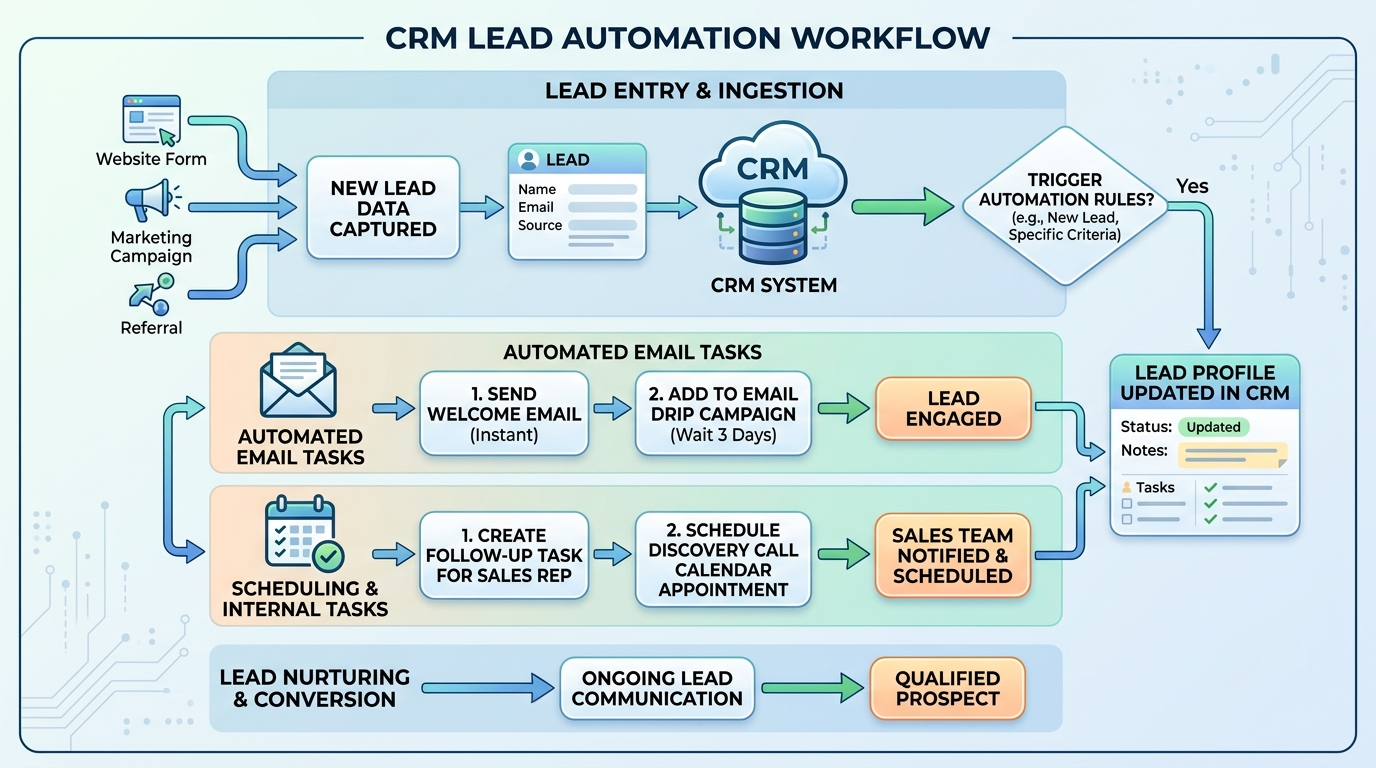
Many business owners view a CRM as a necessary chore. That is a mistake. When implemented correctly, it becomes a growth engine that directly impacts your bottom line.
Research from 2026 shows that businesses see an average return of $8.71 for every $1 spent on CRM systems. Most firms realize positive ROI within 12 months, with tangible productivity gains appearing as early as 90 days after implementation.
Consider the cumulative effect of these gains:
- Shorter sales cycles: Automation reduces the time between initial contact and a signed contract by 8% to 14%.
- Higher revenue: CRM users consistently report 29% higher revenue by capturing leads that would have otherwise fallen through the cracks.
- Better forecasting: With accurate, real-time data, you can predict cash flow and staffing needs with 42% greater accuracy.
Important context: The global CRM software market reached $109 billion in 2026. If you aren't using one, you are likely competing against businesses that have already automated the tasks you are still doing manually.
Beyond Sales: Managing the Full Customer Lifecycle
A common misconception is that CRM automation for service businesses is only for the sales team. For a service provider, the real value lies in the post-sale experience.
You need to coordinate the entire lifecycle, not just the initial pitch. A good system handles:
- Scheduling and reminders: Automated appointment booking prevents no-shows and saves you from the "when are you free?" email ping-pong.
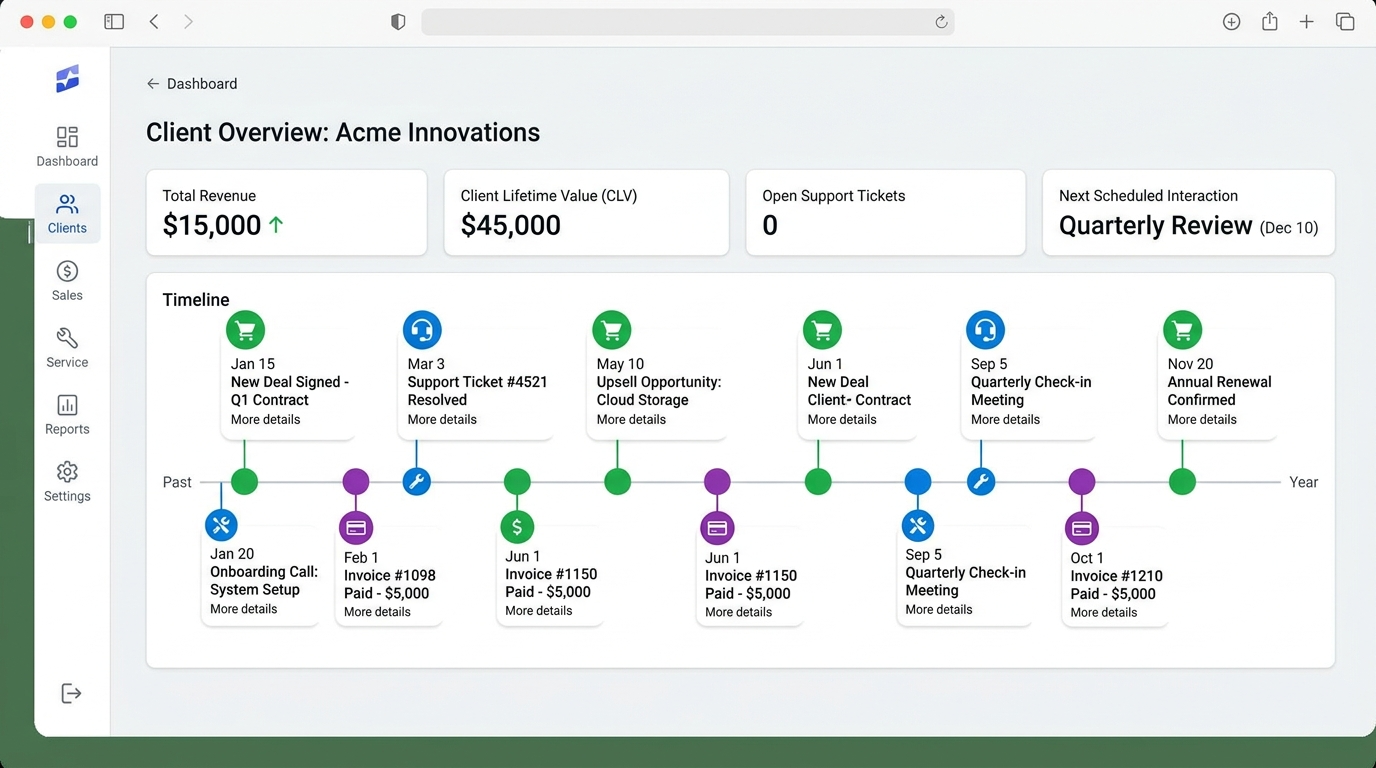
- Support history: By syncing customer service requests to their profile, you ensure that every team member knows exactly what was discussed last time, providing a seamless experience.
- Billing and cash flow: Automating invoices and payment reminders keeps your revenue moving without you having to hunt down overdue accounts.
How AI is Changing Small Business CRM
AI is no longer a futuristic luxury; it is now considered a standard feature in 65% of CRM deployments. If your software isn't using AI, you are using legacy technology.
Modern CRMs use AI to act as a silent partner. Instead of you manually reviewing 50 leads to see who is ready to buy, the software performs lead scoring to highlight your hottest prospects.
Newer systems go further by offering "next best action" recommendations. The software analyzes the client's behavior and suggests, "Send this case study now," or "It’s time to reach out for a renewal." It removes the guesswork from your daily outreach.
Quick tip: Use automated sentiment analysis to flag unhappy clients early. If an email thread contains frustrated language, the CRM can automatically escalate that ticket to a senior team member.
Don't be dazzled by CRMs that promise 500 features. Most of them are just clutter that will make your team less productive.
Prioritize ease of use above all else. If your staff finds the interface confusing, they simply won't use it, and your data will become stale. Look for integration depth—how well does it play with the tools you already use, like your accounting or email platform?
For service businesses specifically, look for these industry-specific requirements:
- Mobile/Offline access: Essential for field technicians or consultants who spend time on the road.
- Customer portals: Allow your clients to view their own history and upcoming appointments.
- Service-specific routing: The ability to auto-assign tasks based on staff location or expertise.
Common pitfall to avoid: Do not buy a generic, enterprise-grade CRM that requires a full-time administrator to manage. For most small businesses, a mid-market, intuitive tool is vastly superior.
Getting Started: A 3-Step Action Plan
Ready to streamline business operations? You don't need to rebuild your business overnight. Start with this simple 3-step plan:
- Audit your manual tasks: Spend one week tracking where you waste the most time. Is it manually copying email info? Sending payment reminders? Start there.
- Map your customer journey: Write down every touchpoint a client has with you from the first "hello" to the final invoice.
- Pilot with one workflow: Pick the most painful part of your process—for example, automated appointment reminders—and implement that in your CRM. Prove the value, then move to the next task.
Frequently Asked Questions
What is the expected timeline to see results from CRM automation?
Most service businesses start seeing initial operational benefits within 90 days. You will likely notice a reduction in administrative hours almost immediately, while measurable revenue increases typically follow within 6 to 12 months as your lead tracking and follow-up processes mature.
Do I really need AI features in my CRM?
For a small business, "AI" usually just means better automation. You don't need deep machine learning to start, but having features like auto-logging of emails and basic lead prioritization is essential to staying competitive in 2026. These features reduce human error and ensure that your database is always accurate.
Is CRM automation too complex for a small team?
Not if you focus on the right tools. The market is saturated with options designed for small teams that prioritize "plug-and-play" integrations. If you feel overwhelmed, it is usually a sign that you are looking at a tool that is too complex for your current size.
Still feel like you're drowning in manual tasks?
At CodeRift Agency, we specialize in helping service businesses build the right technology foundation to scale. Book a free audit call today, and let’s identify the one automated workflow that will give you back five hours of your week.